“The year was 1900, ‘tis worth remembering / the men who lived through 55 days at Peking / It was called the Boxer Insurrection, a bloody oriental war / against all nations of the diplomatic corps / the flags of France and Britain, how they fluttered in the breeze / the Italians and Russians / and the flag of the Japanese / then came the sound of bugles, the rolling drums of doom / and the streets of Peking, were as empty as a tomb” (55 Days at Peking, the Song of 11 Nations). The song of 11 nations, although there are only 9 renditions of it – one of them in the Qing Dynasty perspective – the American version never mentions America. The American perspective of 55 days at Peking, the Boxer Insurrection, in China, is largely untold. The former relationship and concessions the U.S. had with the Qing Dynasty are largely unknown among the public and not really discussed among historians. Although we only committed 2500 troops – the Japanese 10000, the Russians 3000, the British 3000 – we still committed more than the French (800), Austro-Hungarians (few), German (few), Italians (few), Belgians (few), and the Dutch (few). So we had a stake in the war, though it is never talked about what we gained from it, nor what its previous relations with the Qing Dynasty were. This battle, this war, is largely forgotten in American history, and it would be interesting to see America’s perspective. The aspects of the American perspective that will be examined are the previous relations with the Qing Dynasty, our role in the actual siege, and the concessions we gained after the war.
So, what were our previous relations with the Qing Dynasty? Well, we had many deals and treaties in the past, it was mostly laissez-faire – live and let live – in shorter terms, we were hands off. The two most significant events that would actually gain us something (debatably) are the results of the Sino-Japanese War: “Japan gained additional rights within China, such as the right to build factories. The U.S. also obtained these rights through the most favored nation principle while simultaneously becoming a competitor with Japan in Southeast China” (uscpf.org). These factories have been challenging to find. Surfing through documents and maps, it is very likely the U.S. had none, or few enough that we weren’t prominent oppressors. So it is debatable whether the U.S. even oppressed them. Even as gains were made during the opium wars, the U.S. never used them. They agreed to trade with the U.S. too, “According to the Office of the Historian, the treaty ‘provided the basis for the expansion of trade’ and ‘served as the model for subsequent treaties between China and other Western nations’” (uscpf.org). It is hard to say the U.S. gained anything from this; while we did trade with them, the trade wasn’t really unequal in nature. It was actually decently fair, and we didn’t really have foreign offices in China. On top of this, men like Herbert Hoover were left to teach the Chinese capitalist business practices and help the population become more independent. Safe to say, before Peking and the Boxer Insurrection, Sino-American relations weren’t really sour, it was more static. The U.S. wasn’t a cruel oppressor and seemed to involve itself little in the private affairs of China; it was more helpful for China than oppressive.
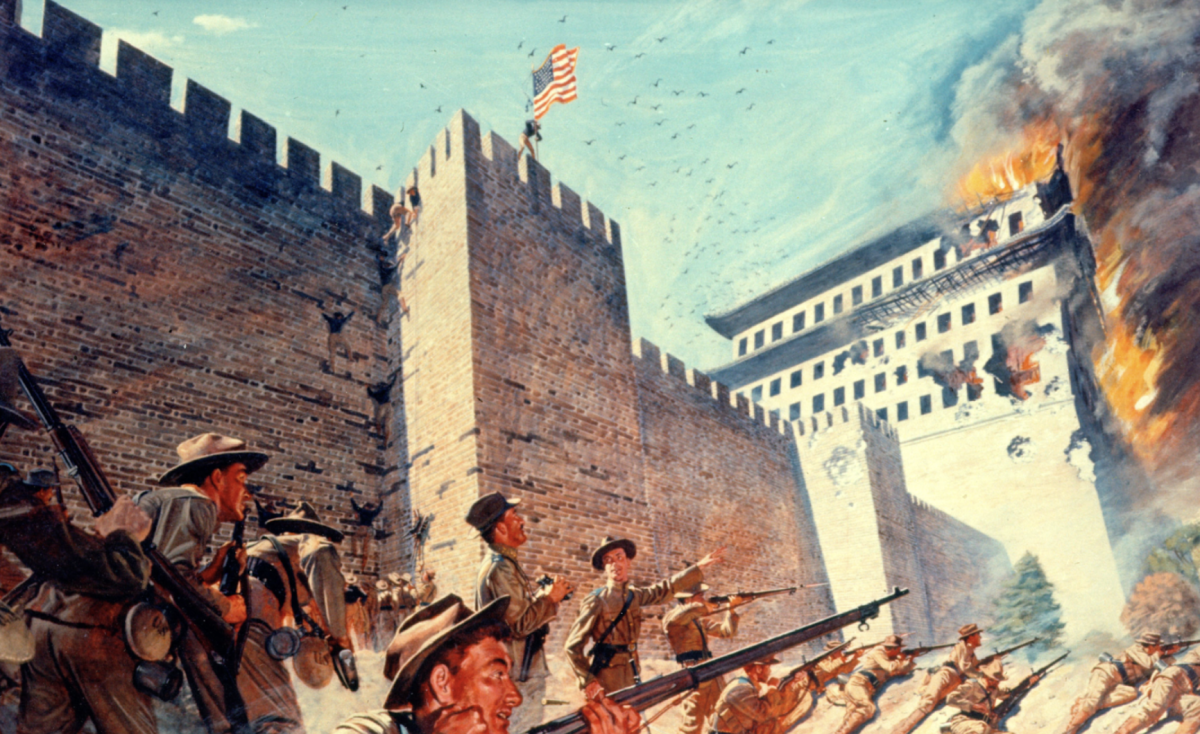
In the actual boxer insurrection, as mentioned, the relief force had 2500 Marines. However, the most important feat was at Meyer’s wall. Where Captain Meyers stormed the wall of Peking that was overtaken by boxers, and he was wounded, and two marines were killed, but the 11 nations got the wall back. The war aims of the U.S. were strangely noble in their objectives, relieve the Marines defending Peking and protect American citizens in the region. It is noted that the U.S. fought the hardest to defend Peking, and our Marines worked to save the other nations and their people. Even in the context of the looting that took place, we didn’t do much. While it was present, Adna Chaffe condemned the practice, and the U.S. was the only nation to do so. He ordered Marines to return stolen goods, though some disobeyed; most of the Marines did not dishonor the corps. Yankees were defenders and heroes, and Yanks didn’t even oppress the populace. So, during the actual 55 days, the U.S. played an important role in defense and was the most disciplined army among the 11 nations. The Marines won many medals, most of which had to do with bravery. “Individual honors were bestowed on many marines in the wake of the Boxer Rebellion. Thirty-three enlisted men were awarded the Medal of Honor, including the first medal awarded to a marine posthumously. Pvt. Harry Fisher was killed on July 16 while helping erect a barricade near the wall in Peking. Pvt. Dan Daly received his first Medal of Honor for volunteering to stay alone on the bastion of the wall while undergoing constant fire from the enemy on the night of July 15.26 Marine Corps officers were not eligible for Medals of Honor until 1913” (archives.gov). So, the U.S. did many gallant things to defend, attack, and save people.
Post-Peking, America once again championed humans before spite. It should be stated that all nations were awarded money as reparations; however, the U.S. used its share for moral adventures, “In 1901, foreign powers forced the Qing Dynasty to sign a settlement called the Boxer Protocol in which the Qing Dynasty court was required to pay more than $330 million to foreign nations in reparations, significantly weakening the already troubled Qing Dynasty. The U.S. later used their share of the reparations to fund scholarships for Chinese students to study in the U.S.” (uscf.org). The U.S. used its money to assist the Chinese in gaining an education, and it was used to benefit China. Education is important in developing the nations of the world; it can make a nation successful. In-fact, educational endeavors early on became one of the most fruitful arenas for the Cyno-American collaboration, “In the first decades of the 20th century, dozens of schools and colleges were established in China, altogether teaching between 10 and 20 percent of China’s post-secondary students in any given year. These institutions emphasized instruction in English, philosophy, religion, and the sciences, and also stressed physical education and athletics” (china.usembassy-china.org.cn). Even after this event, where the U.S. was betrayed, did we help China in their endeavors. Even after Meyers, and hundreds of Yanks met their end, the U.S. still came through to assist China. It should be noted that, after Peking, we still assisted this old nation.
60 years prior to the fateful day in 1900, we would fight Polk’s War of Expansion (The Mexican American War) against Mexico. The United States comitted many atrocities, like throwing children off the top of Chapultepec, and raping and killing women. In-fact, two years prior to the 55 days spent at Peking, in Roosevelt’s War (The Spanish American War), the U.S. fought entirely for colonial expansion. What Peking, and our Sino-American relations show, is the nuance of history. The U.S. did many terrible things, and their relations with the Chinese demonstrates a historical oddity in our treatment of foreign entities. In an American-Historian’s gaze, this is something pride can be applied to, as we were uniquely kind and charitable to the Chinese.
America’s perspective on the Boxer Insurrection and China as a whole can be summarized pretty well in one sentence: We came, we saw, we helped. Although we were mentioned in some corrupt set of treaties, we never abused the Chinese people in China. The U.S. was the only true friend of China, as its share of reparations was used to help China prosper in genuine ways. However, when push came to shove, the U.S. defended herself and defended her people. The reason this isn’t in public consciousness, the reason it isn’t talked about, is because it isn’t useful for the Chinese narrative. Saying the U.S. was in the Unequal Treaties, Peking, and a part of the 11 nations, sounds much better than actually discussing the U.S.’s honest role in these things, as if you want to set a historical enemy, you can’t go into detail of the good they did to you. Meyers made his stand against Chinese tyranny, it’s time we make ours, spread the word of the U.S.’s deeds, for “The drums have long been muffled / the bugles cease to ring / but through the ages / you can hear them echoing” (55 Days at Peking, the Song of 11 Nations).